Waterfront Notes · Lake Austin
On October 12 the Lower Colorado River Authority will begin lowering Lake Austin about ten feet, and it will hold there until refill starts on November 24.
For owners between Mansfield Dam and Tom Miller Dam, this is the first chance since 2017 to stand on the lakebed under their own dock. The dates you have seen published are not the dates you can work.

Lake Austin is operated inside a one-foot band for most of its life. This fall it will sit ten feet below it.
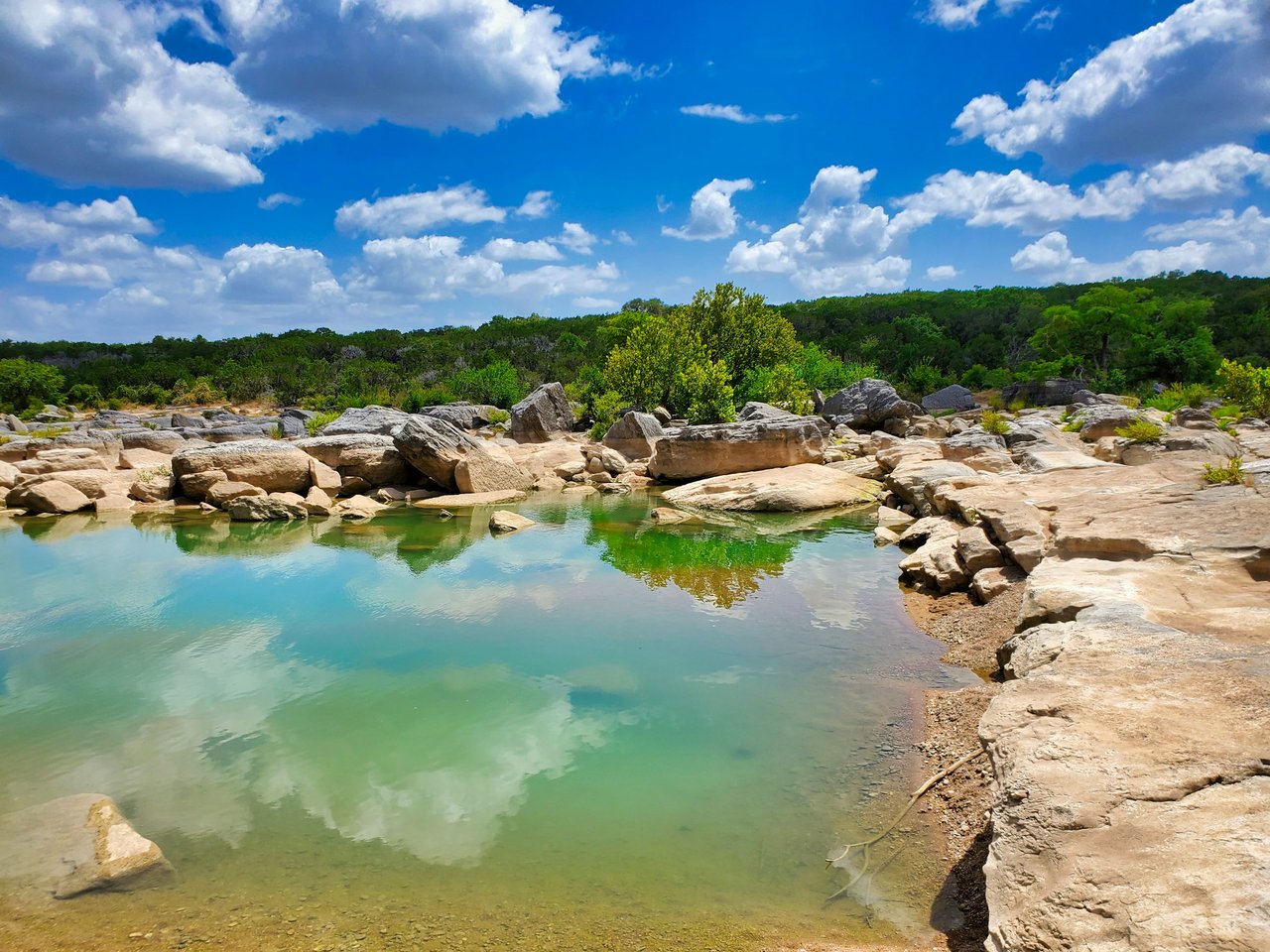
Greeshma Gangadharan / Unsplash
10 FT
The drop
3 WEEKS
Actual working window
2017
The last one
A note on this post
I have nothing to sell you here. A drawdown is not a market event; it is a maintenance window, and the owners who get real value out of it will be the ones who understood the permitting sequence in August rather than in October.
01
The facts, and one correction
The lake comes down at no more than about a foot a day starting October 12, and LCRA expects roughly three weeks to reach its target of 481.8 to 482.8 feet above mean sea level. Normal operating range is 491.8 to 492.8.
Refill begins November 24 at up to two feet a day, released from Lake Travis, and the lake is back in its normal range by November 30. Public boat ramps are closed throughout, and there is no swimming at Emma Long.
The City asked LCRA for the drawdown, in its own words, "in response to stakeholder requests."
A correction worth making
Lake Austin is routinely described in local real estate copy — including copy I have written — as a constant-level lake.
LCRA's own FAQ says flatly: "None of the Highland Lakes are constant-level lakes." Travis and Buchanan hold the storage. Austin is a pass-through lake held in a narrow band — an operating practice, not a physical guarantee. Which is exactly why a ten-foot drawdown is possible.
As for how rare this is: a City memo to Mayor and Council dated October 10, 2025 counts eight drawdowns between 2001 and 2011, and exactly one since.
Plan as though the next one is far off, because on that record it is.
02
The window is shorter than the dates suggest
Seven weeks are on the calendar. You do not get seven weeks.
The lake descends at roughly a foot a day and takes about three weeks to bottom out, then refill begins November 24. Full exposure runs from around the start of November to Thanksgiving week.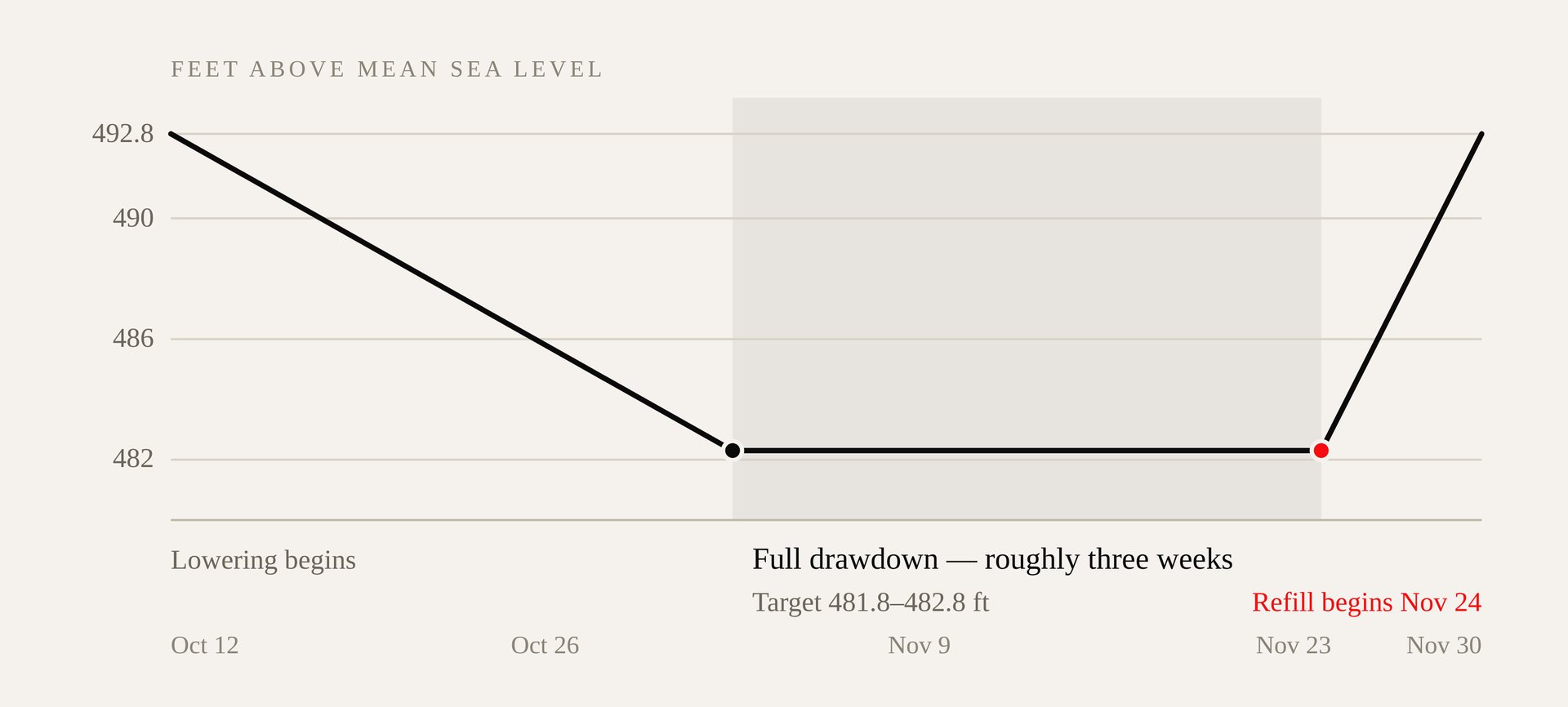
A subtlety in that curve should drive your scheduling: exposure is progressive.
The top of a bulkhead is dry in the first week. The bottom of a silted slip may not surface until the lake is nearly at target. Cap and upper-wall repairs can start early. Dredging and footing work waits on the last two feet — the feet the schedule is least certain about.

The structures that carry the most value on a waterfront lot spend nearly all their life partly underwater.
Fifteen years, two windows. Whatever the future cadence turns out to be, it is not annual.
03
The permit picture
First, the thing that trips people up: LCRA controls the water, the City controls the shoreline.
LCRA permits docks on Buchanan, Inks, LBJ, Marble Falls and Travis, and says on its own page that the City is responsible for Lake Austin dock regulations. The agency lowering your lake is not the one that will approve your repair.
Tier | Covers |
|---|---|
No permit | Paint, stain, limited landscaping, placing furniture, limited lighting. |
Site Plan Exemption | Simple re-decking. Repair and maintenance of an existing structure. Bulkhead repair not exceeding 25% of the bulkhead, provided no repair was done without a site plan in the previous three years. |
Full Site Plan | New construction. Any change to a structure. Replacing load-bearing beams, walls, piers or pilings. Adding walls. Demolition. Expanding the footprint. Placing anything below water elevation. |
City of Austin Development Services. Governing code: LDC Ch. 25-2, Subchapter C, Article 13.
Read that middle row twice. The exemption removes the site plan, not the permit — and it evaporates the moment you replace a load-bearing element.
A piling is load-bearing. If your builder finds rot in a pier once the water is down, your project has changed tiers in the middle of a three-week window.
The announced accommodation is a dedicated Site Plan Exemption application for minor dock and bulkhead repairs during the drawdown. The City says it will be available "in the coming weeks." As of this writing it has not been posted — watch AustinTexas.gov/Boat-Docks.
If you take one number away
25 CUBIC YARDS
Under LDC 25-8-261(C)(9)(a), the code allows up to 25 cubic yards of dredging for navigation safety per site plan permit application. The allowance attaches to the application — not to your property, and not to the drawdown.
Go above it and you need a variance, which is not one meeting. The Environmental Commission reviews and recommends; the Land Use Commission decides. That is the sequence the Taylor Slough dredge went through in 2025.
Twenty-five cubic yards is roughly two and a half dump-truck loads. A slip quietly silting since 2017 can exceed it without looking like it does.
Get a volume estimate before October. That number decides whether this drawdown is a work window, or simply a very good look at a problem you will be solving in 2027.
And if your scope involves fill rather than removal, the Army Corps of Engineers regulates that under Section 404. The City's own dock handout sends applicants to the Fort Worth District.
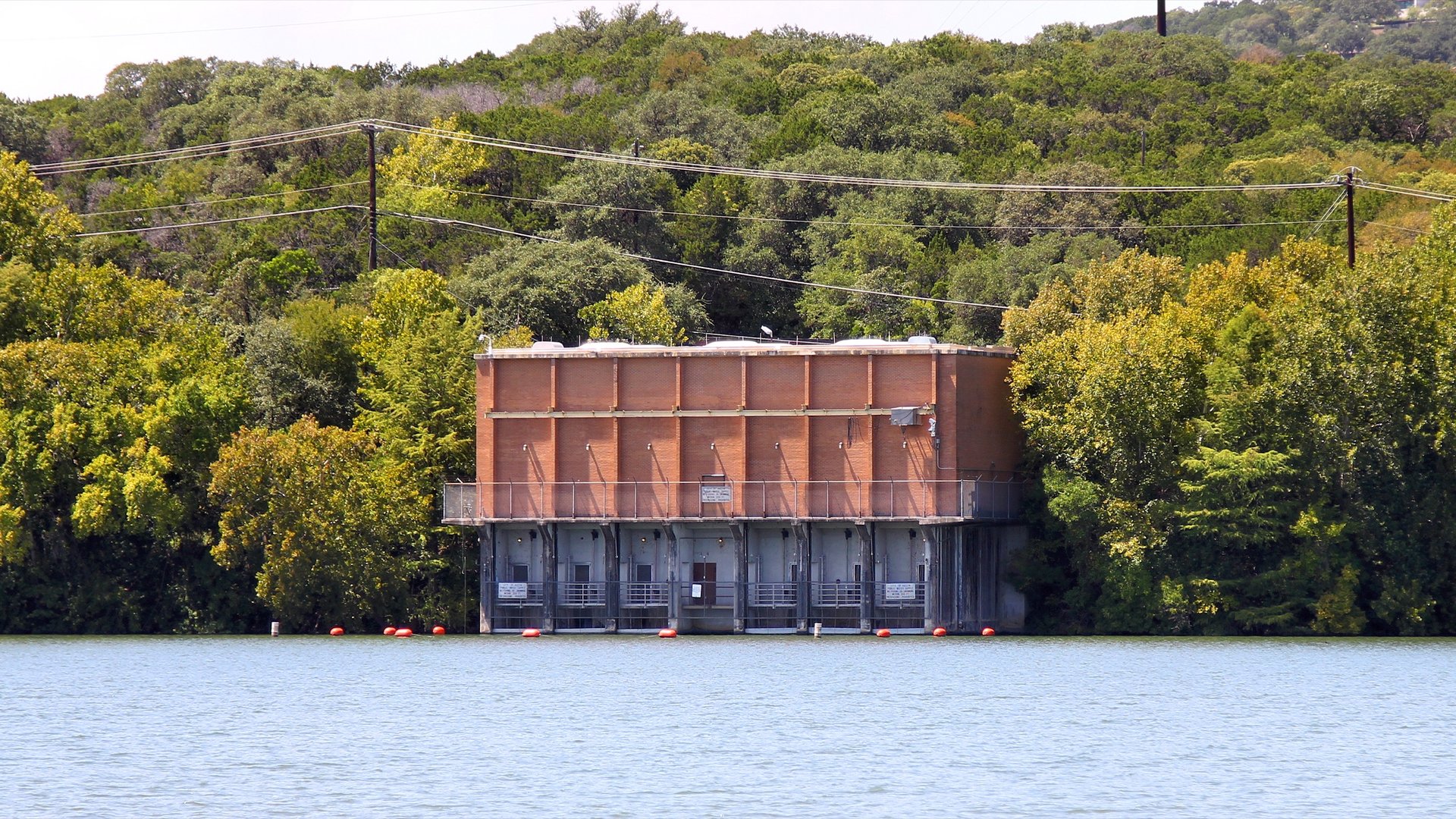
Scenery and infrastructure at once. Lake Austin is also a drinking-water source, which is part of why so many agencies have a say in it.
Wikimedia Commons
04
The state layer almost nobody mentions
The City's announcement notes in passing that some activities may require Texas Parks and Wildlife permits. Two provisions underneath that sentence are where well-intentioned owners are most likely to break state law this fall.
Vegetation
Managing nuisance aquatic vegetation in Texas public water generally requires a treatment proposal filed with TPWD at least fourteen days before work begins, under the State Aquatic Vegetation Plan at 31 TAC 57.932.
There is a lakefront landowner exception, narrower than it sounds in two ways. It reaches only floating aquatic plants — and hydrilla is rooted and submersed. It also does not extend to persons hired solely to remove vegetation, or to anyone using a mechanical harvester. The exception most likely to be invoked this fall does not cover what most owners will actually do, which is hire a crew.
Zebra mussels
TPWD classifies Lake Austin as fully infested. Moving a vessel, dock or pier with zebra mussels attached is illegal in Texas.
TPWD's boat maintenance movement notice is the exception: notify the department at least seventy-two hours before moving one to a service provider for removal or repair. The general regulation text is written around boats while the notice form names docks and piers explicitly — so if you plan to float a dock section out for shop work, call TPWD rather than rely on this paragraph.
05
Where this leaves the hydrilla question
A great many people wanted this drawdown for the hydrilla. It is worth being straight about what it will and will not do.

Underwater hydrilla growth. Representative image, not Lake Austin.
Ryan Hagerty / USFWS
The lake carried 575 acres of hydrilla and 75 acres of Eurasian watermilfoil at the June 2026 survey. That is a real problem, and in parts of the upper lake it has made summer boating close to impossible.
Lowering the lake is unlikely to fix it — and that is not my opinion. The City's October 2025 memo reviewed data from 1999 through 2025 and found that drawdowns "are not effective at controlling hydrilla," and that the record suggests they may "have the opposite effect, facilitating hydrilla's growth by reducing competition from other aquatic plants in shallow areas."
The City requested one anyway, on maintenance grounds, while noting it does let owners plan localized mechanical removal near their own shoreline.
So the honest framing is narrow. This window is an opportunity to clear what is in front of your property — not a lake-wide treatment. And if that is the plan, re-read the vegetation rules above before hiring anyone. For the fuller picture, I wrote about it separately in Hydrilla on Lake Austin.
06
A working checklist
One
Book the contractor before you finalize the scope. Every dock builder, bulkhead crew and dredging outfit on this lake is working from one three-week calendar. Capacity, not permission, is the binding constraint.
Two
Get the slip volume estimated now. Above or below 25 cubic yards is the question that decides your fall.
Three
Go to the open house. Wednesday, September 9, 6–8 p.m. Permitting and Development Center, 6310 Wilhelmina Delco Drive, Room 1407 — five weeks before the water moves.
Four
Sequence the work by depth. Upper bulkhead and decking first, deep slip work in the middle weeks, with slack on both sides of anything requiring full drawdown.
Five
Have a contingency for a changed tier. Ask your builder in advance what happens if they open it up and find a compromised piling.
Six
Do not leave equipment unattended in the lakebed. LCRA's guidance is to remove tools from the shoreline whenever they are not in use, not merely overnight.
Seven
Treat the schedule as conditional. LCRA reserves the right to shorten or cancel for flooding or power shortages. A scope that only works if you get every day of the window carries a risk.
One more, for owners with no planned scope: use the window anyway.
Nine years is a long time to defer inspection on the most expensive structure between your house and the water. Undermined footings, corroded hardware, a slip gone quietly from adequate to marginal — cheap to find in November, expensive later.
07
Why fall, and not winter
Owners who have been here a while remember drawdowns as a January event. That changed after February 2021.
In LCRA's words, following Winter Storm Uri it "determined it would no longer conduct lake drawdowns in the winter to help ensure the hydroelectric generators at dams along the Highland Lakes remain available to fully support the Texas power grid during the cold winter months."
The scale is smaller than most assume. Mansfield is rated at 108 megawatts and Tom Miller at 17; all six Highland Lakes dams come to roughly 295, against an ERCOT peak above 91,000.
Not a criticism — capacity during a scarcity event is not valued in proportion to its nameplate. But it is worth knowing the size of the constraint that moved your maintenance window out of quiet January and into hunting season, the holidays and the end of the construction year.
08
What this has to do with value
I will resist the usual move. There is no credible published study of a Lake Austin waterfront premium — the percentages circulating in brokerage material trace back to nothing, and Texas is a non-disclosure state, so even the sale figures everyone quotes come from MLS reporting rather than public record. I am not adding another invented number to that pile.
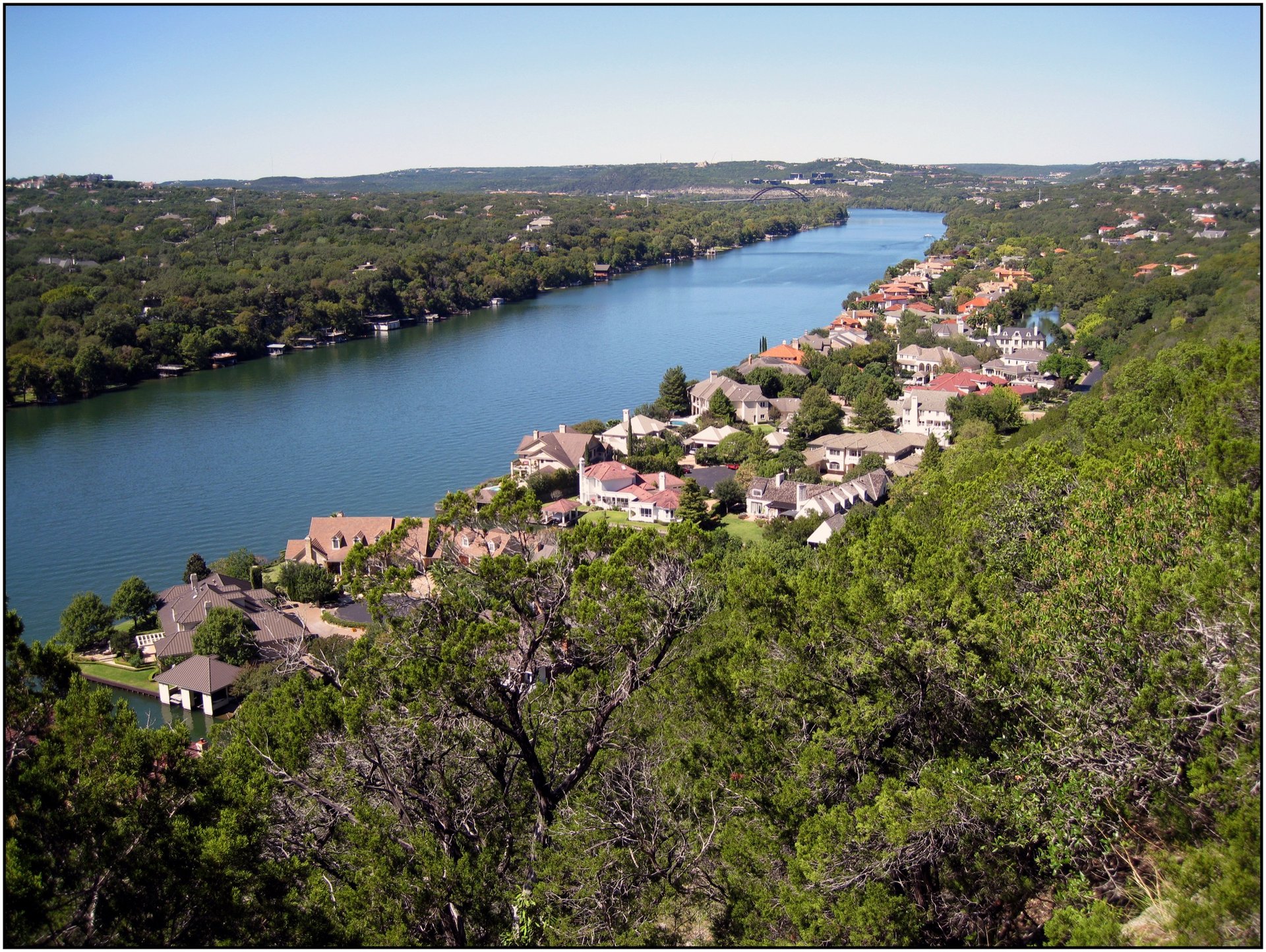
Roughly twenty miles of shoreline, and the lot count does not grow. What separates these properties is usually the water's edge, not the house.
Wikimedia Commons
What I can tell you is structural, and more useful anyway. Under Article 13, dock scale is governed by shoreline frontage, not acreage. Width is capped at 20 percent of frontage, with a 14-foot minimum for lots with 70 feet or less. Footprint is capped at 1,200 square feet, extension at 30 feet, side setbacks at 10 feet, and slips at two motorboats.
Frontage width, not lot size, determines the dock you are permitted to build. That is the sentence most Lake Austin buyers learn a year too late.
Which is why the condition and permit status of what sits at the water's edge does real work in a transaction. A dock that is sound, registered and documented as permitted is a different asset from one that is none of those things on an identical lot. This window is one of the few chances to move a property from the ambiguous column into the documented one — whether you sell in five years or never.
If it's useful
I know the people who work this shoreline — dock builders, bulkhead crews, dredging outfits, and the marine inspectors worth calling before you commit to a scope. If you would like an introduction, get in touch.
And if you have no intention of ever selling and just want to think out loud about your slip, that is a fine reason to call too. Most of the worthwhile conversations I have on this lake are with people who are not going anywhere.
Sources & further reading
City of Austin and LCRA joint news releases, August 20, 2026 · City of Austin memorandum, "Staff update regarding a drawdown of Lake Austin," October 10, 2025 · City of Austin Development Services, Boat Docks · Austin Land Development Code Ch. 25-2 Subchapter C Art. 13, and LDC 25-8-261 · LCRA, Dams and Lakes, and LCRA Frequently Asked Questions · Texas Parks and Wildlife Department: State Aquatic Vegetation Plan (31 TAC 57.932), Aquatic Vegetation Removal Permit for Exotic Species, zebra mussel classification and boat maintenance movement notice · City of Austin Watershed Protection, citing the June 2026 TPWD vegetation survey · ERCOT peak demand records.
Drawdown schedules, permit requirements and lake conditions change. Confirm current requirements with the City of Austin and LCRA before scheduling work or signing a contract.
Sean Smith is a Real Estate Advisor, REALTOR® with Engel & Völkers Austin. Nothing in this article is legal, engineering, environmental or construction advice. Permitting determinations are made by the applicable agency for a specific site.