
Land & Capital
The New Luxury Is Control
The Quiet Consolidation
The migration made the headlines. What the money did next is the real story.
Data note
Data and project status current as of August 4, 2026. This staging draft preserves the supplied reporting language. Items awaiting final source, legal or methodology review are listed in the separate Editor Query / Change Ledger.
I
Two Markets, One Region
By most conventional measures, Austin's housing market has spent the past three years coming back to earth. The metro's median sale price, which touched roughly $550,000 in May 2022, had given back close to a hundred thousand dollars by the middle of 2025. Days on market stretched from a frenzied two weeks to a civilized month and a half. The bidding wars ended. The out-of-state license plates thinned. Depending on which national outlet you read, Austin became either a cautionary tale or a buying opportunity.1
Drive forty-five minutes west and the story inverts.
In the first quarter of 2026, rural land in the Texas A&M Real Estate Research Center's Austin–Waco–Hill Country region — the broad crescent of ranch country that wraps around the city — reached $8,028 an acre, an all-time record, up more than eight percent in a year. It was among Texas's most active land markets, with 1,078 annualized sales, 53,554 acres changing hands, and $429.93 million in annualized volume; prices rose in every size category the researchers track.2
Two markets, one region, moving in opposite directions. That divergence is not abstract in my work. In my work advising luxury buyers and sellers across Austin and the Hill Country, I see clients spending less time chasing the next hot neighborhood and more time evaluating the variables around how they want to live — privacy, water, access, land use, and what can be built nearby.
The story is happening in fence lines. In water wells and wildlife surveys, in conservation easements and quietly assembled adjoining tracts. The new luxury in Central Texas is not a larger house. It is control — of privacy, of water, of a view corridor, of what happens on the other side of the hill. And the capital pursuing it is changing the geography of the region in ways that will outlast any housing cycle.
II
The Market That Cooled, and the One That Didn't
Start with a paradox inside the city itself. While Austin's overall market softened, its luxury segment just produced a record year: roughly $4.6 billion in million-dollar-plus sales in the twelve months ending October 2025, more than 2,700 transactions, up about half a billion dollars over the prior year. Within that segment, the pattern sharpens with altitude. Brokerage analyses of mid-2026 data show the broad luxury median down modestly from its 2022 peak — while the $3 million to $5 million tier appreciated nearly four percent year over year, and the $5 million to $10 million tier nearly five. Roughly 38 percent of Austin luxury purchases closed in cash in the most recent brokerage tallies.3
Taken together, the numbers describe a divided market: the middle corrected; the top compounded. For a seller in Westlake, a buyer considering Bee Cave, or a family comparing a city residence with acreage, the broad Austin median is context — not a pricing strategy. The upper end has its own inventory, motivations, and pace, and it has become noticeably more selective.
The land data suggests where some of that capital went. Statewide, Texas rural land ended 2025 at a record $5,214 an acre, and the state's researchers noted something telling about seller psychology: landowners have simply refused to reprice. Asking prices remain "anchored to the peak prices of 2022–23," as the Texas A&M center put it — and rather than collapsing, the market gradually rose to meet them. Charles Gilliland, the center's veteran land economist, described the data-center money now hunting rural Texas acreage in hydrological terms: "a flash flood of cash."4
Housing responded quickly to changed financing and inventory. Many landowners, by contrast, were willing to wait rather than reset their expectations.
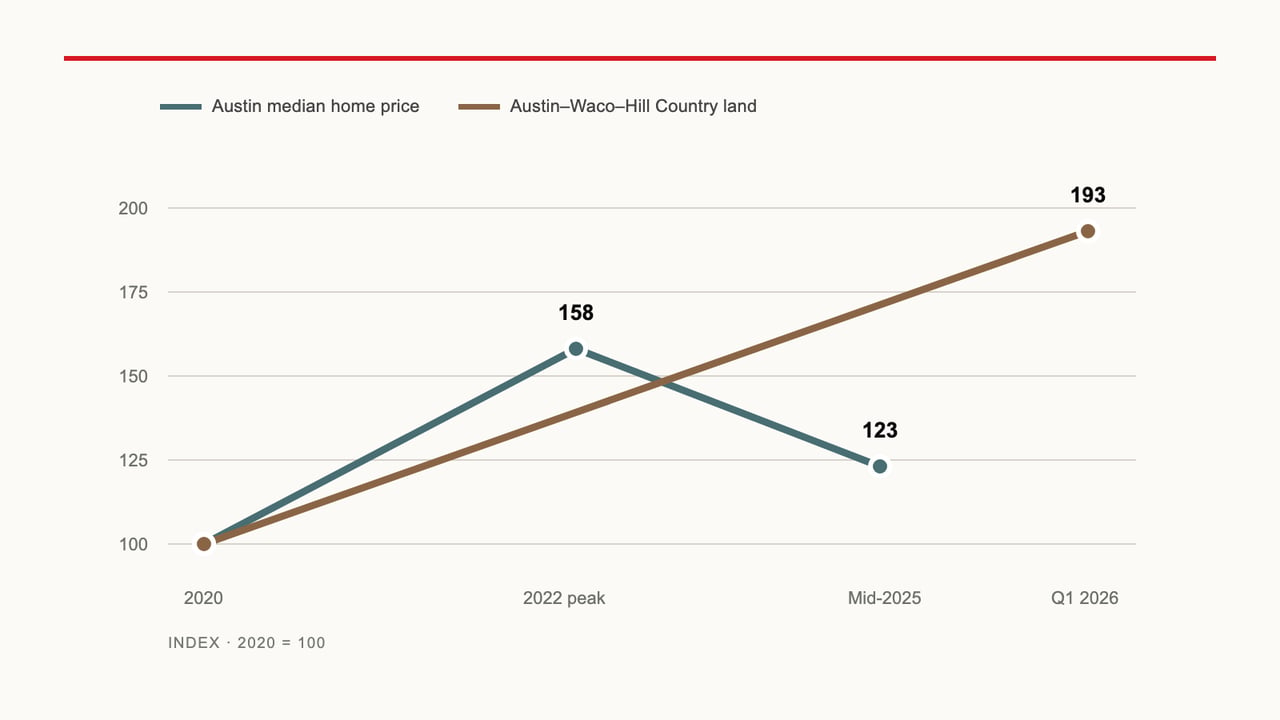
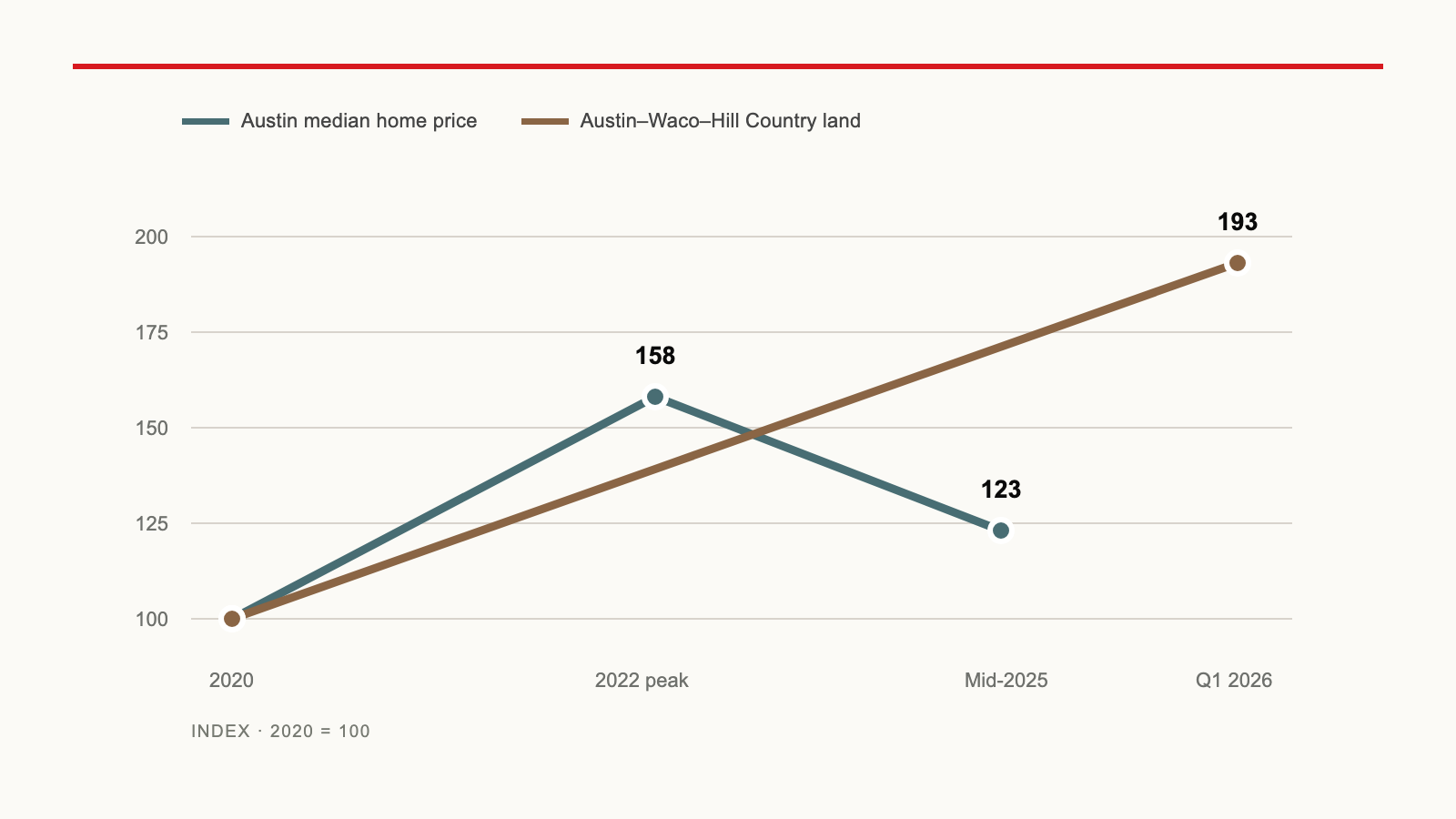
Two markets · 2020 = 100
The divergence after the boom
Austin housing surrendered part of its pandemic gain. Region 7 rural land nearly doubled from its 2020 level. Series use different reporting intervals and are shown as an editorial comparison, not a common price index.
View chart data and methodology
Series | Reference date | Reported value | Index, 2020=100 |
|---|---|---|---|
Austin median home price | 2020 baseline | Derived from TRERC’s 2025 comparison | 100 |
Austin median home price | Pandemic peak | Implied by a 22% decline to $440,000 | 158 |
Austin median home price | Mid-2025 | $440,000; 23% above 2020 | 123 |
Region 7 rural land | Year-end 2020 | $4,164 per acre | 100 |
Region 7 rural land | Q1 2026 | $8,028 per acre | 193 |
Sources: Texas Real Estate Research Center. Final production should regenerate both series from one locked extract; the 2020 land figure predates a later TRERC methodological revision. See the editor ledger.
III
Twenty Years of Compression
The context is two decades of unusually rapid regional change.
In 2005, the Austin metro held about 1.46 million people. By mid-2024 it held 2.55 million — a 74 percent expansion that made it, for twelve consecutive years, the fastest-growing large metro in America. The wealth statistics are more startling than the population ones. Henley & Partners, which tracks the movements of the world's rich, ranked Austin the fastest-growing millionaire hub in the United States, with its millionaire population up 110 percent in the decade through 2023 — ahead of Scottsdale, West Palm Beach, and the Bay Area itself. By the firm's 2024 count, the metro was home to some 32,700 millionaires and 92 people worth more than $100 million.56
The corporate story is familiar — Oracle's arrival in 2020, Tesla's in 2021, 81 corporate headquarters relocations to the metro between 2018 and 2024, second nationally only to Dallas–Fort Worth. But the aftermath is more instructive than the headlines. Oracle moved its headquarters again, to Nashville, in 2024. Tesla cut thousands of Austin jobs the same year. Venture funding fell by nearly half from its 2021 peak. The froth left.
The wealth stayed. City demographic data shows Austin households earning more than $200,000 grew 284 percent between 2010 and 2023 while every income bracket under $75,000 shrank. Whatever else the boom did, it permanently deepened the pool of capital that calls Central Texas home — and pushed a meaningful share of it to ask what, exactly, it was holding. An IRS analysis of the pandemic years found the largest single-year income gains in the region occurred not in Travis County but in the Hill Country counties around it: adjusted gross income up 26 percent in Burnet County in a single year, 25 percent in Llano, 17 percent in Gillespie and Blanco. The money was already moving west before anyone wrote a story about it.
IV
The Buyer Who Learned Patience
The clearest change I see is not simply that buyers have become more patient. They have become more exacting, and nearly everything about the current landscape follows from that shift.
The 2020–2022 buyer was in a hurry. Remote-work money arrived faster than inventory could absorb it; the state's land economists recorded scenes of ranches listing on a Monday and going under contract by Friday, and 2021 alone saw Texas land dollar volume nearly double. In that environment, speed often displaced diligence.
The 2026 buyer behaves differently. Hall & Hall, the ranch brokerage whose average transaction runs $8 million to $10 million, described its current clients as "more patient and analytical," prioritizing "long-term asset performance over rapid acquisition." Live Water Properties reports buyers front-loading due diligence on water and carrying costs before they ever write an offer. That matches the conversations I am having: the serious buyer wants the operating costs, water picture, access, restrictions, and exit considerations understood before emotion takes over.
What has not changed — what has, in fact, been building for far longer than most coverage acknowledges — is who these buyers are. Texas ranch brokers were reporting as far back as the late 2000s that the large majority of their sales went to recreational buyers rather than working ranchers. The ranch market stopped selling ranches to ranchers long before anyone coined a phrase for it.
The pandemic accelerated a lifestyle-land market that had already been developing for years.
What is new in 2026 is the sophistication: buyers who arrive with water attorneys, wildlife biologists, and estate planners, who think in decades rather than market cycles, and who evaluate a property as both a place to live and a complicated bundle of rights, obligations, and future options.
V
Control
When I help a client compare an exceptional house in town with acreage farther west, one issue consistently emerges: control.
A house — even a spectacular one — still leaves many of its most important qualities exposed to decisions made by other people: what gets built next door, what gets widened out front, and how the surrounding area changes. Acreage does not eliminate regulation, infrastructure risk, or neighboring uses. It can, however, give an owner more influence over the immediate setting. In that context, privacy is not an amenity added to the property; it is part of the asset being purchased.
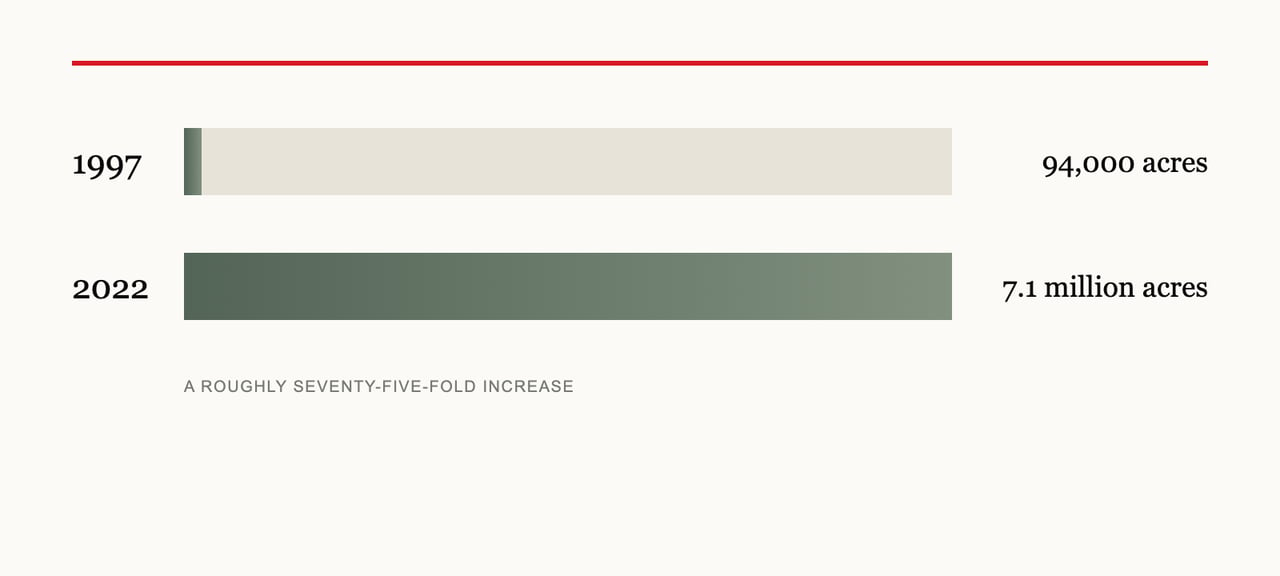
The most revealing statistic in Texas land economics makes the point at scale. In 1997, about 94,000 acres of Texas land were appraised under wildlife-management valuation — the tax classification for owners who manage habitat rather than run cattle. By 2022, that figure was 7.1 million acres, a seventy-five-fold increase. Nothing about Texas ecology changed. What changed was who owns the land and why: acre by acre, the state's countryside has been passing from people who make a living from land to people who make a life on it.7
A change in land use
Wildlife-management valuation acreage
The acreage expanded roughly seventy-five-fold between 1997 and 2022. The statistic documents land-use classification—not owner motive by itself.
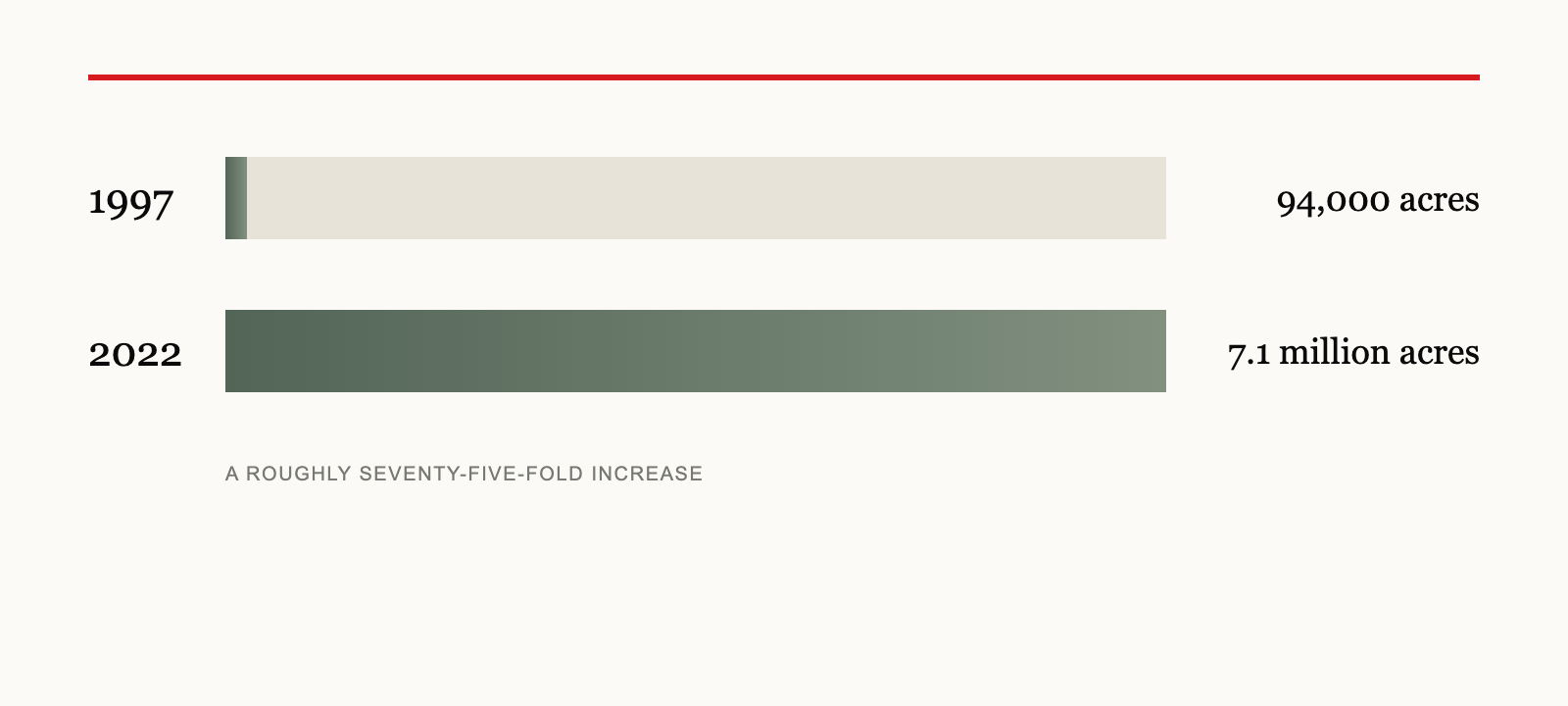
View chart data
Year | Acres | Relative to 1997 |
|---|---|---|
1997 | 94,000 | 1.0× |
2022 | 7,100,000 | 75.5× |
Source: Texas A&M Natural Resources Institute, Status Update and Trends of Texas Working Lands 1997–2022.
The same records show the cost of that transition. Texas lost 3.7 million acres of working farms and ranches between 1997 and 2022 — nearly half of it in the final five years — and mid-sized family operations declined by roughly a quarter while small holdings proliferated. In the Hill Country region, small tracts now trade around $17,529 an acre, more than double the per-acre price of large ones, and the typical sale is about 200 acres. Fragmentation reduces the supply of intact large ranches, while long-term assemblage removes additional acreage from the market for years at a time.72
There is an emotional ledger, too, and buyers should be honest about it. A ranch is one of the few assets a family can stand on, hunt over, plant, name, and hand down. I do not present land as a guaranteed inflation hedge or a substitute for financial advice. Its appeal is more specific: it can serve as a residence, a long-term family asset, an estate-planning consideration, and a place where the next generation builds a relationship with the land.
VI
Water Is the Whole Story
If control is what buyers want, water is where the idea is tested. In my work, it is one of the first diligence conversations on any serious land transaction west of Austin, not a feature to be admired after the house has already won the buyer over.
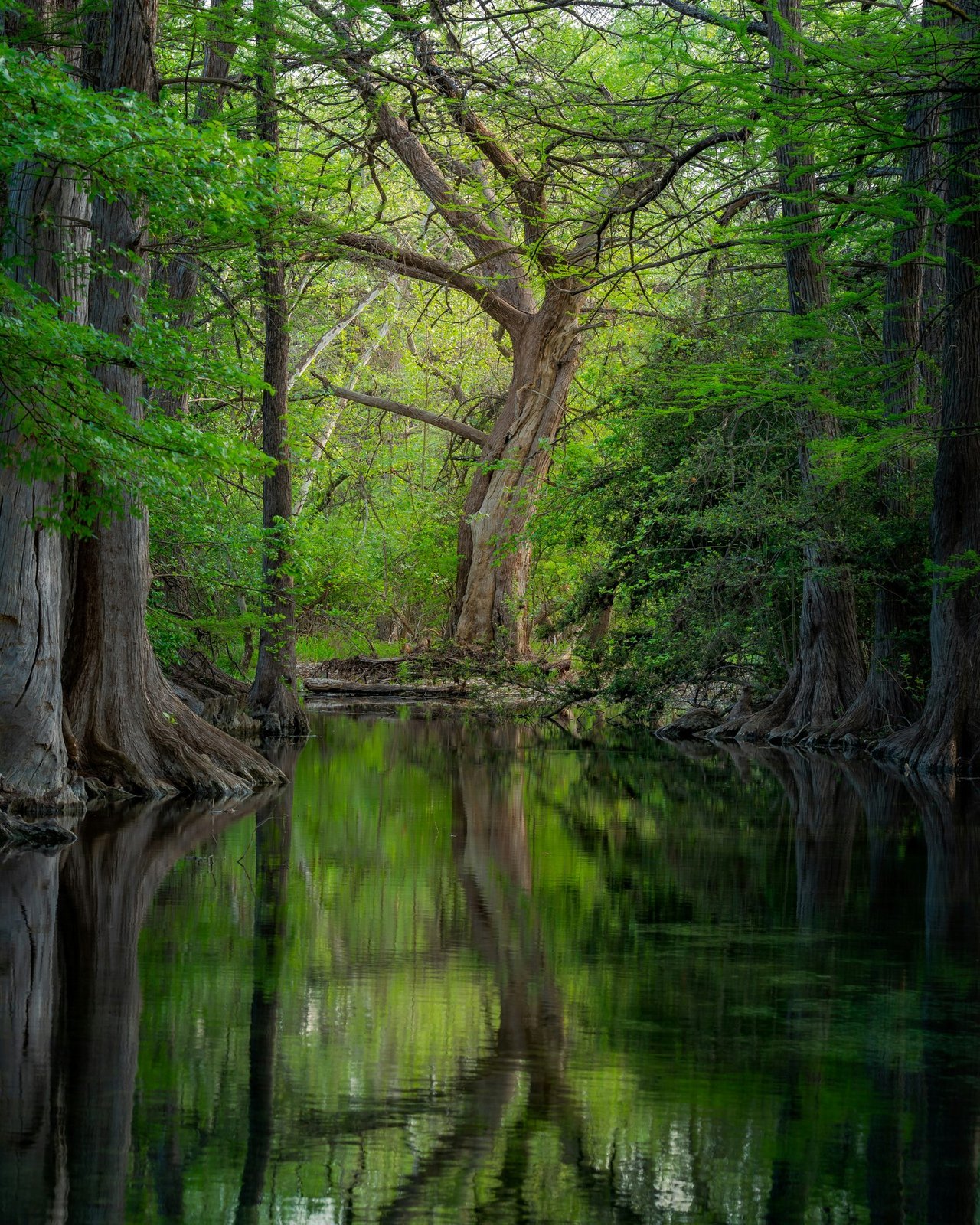
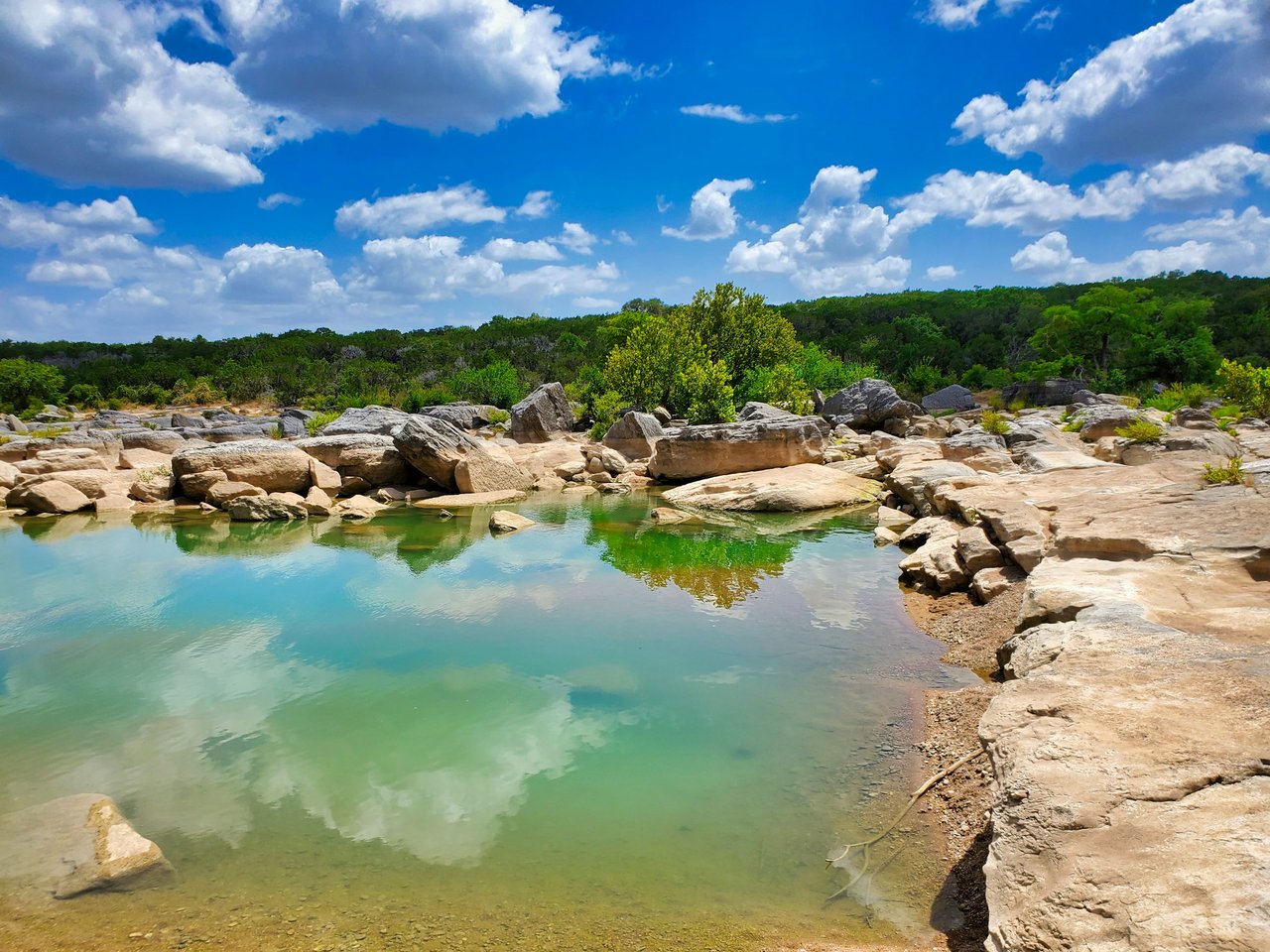
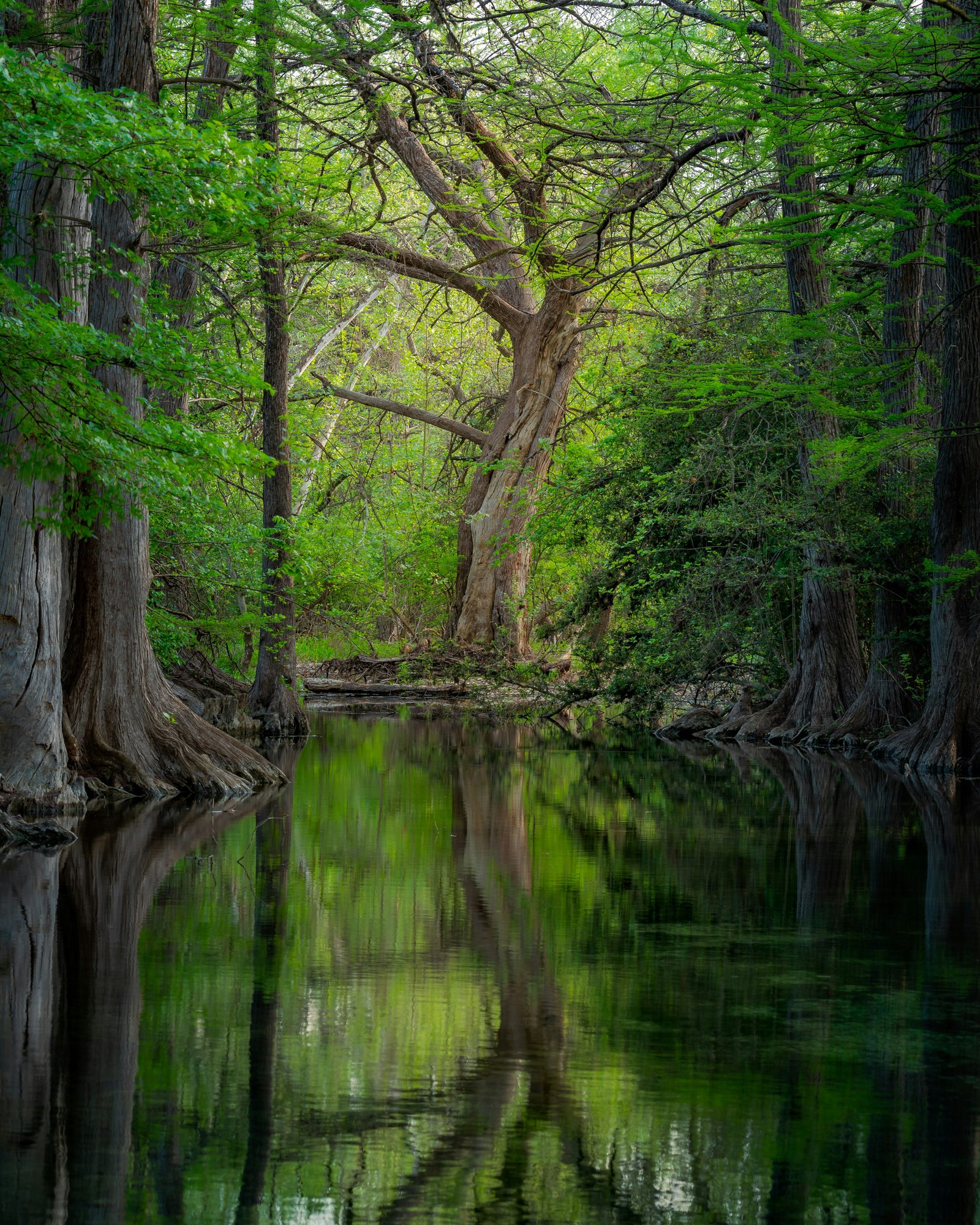
The Hill Country's charismatic assets — spring-fed creeks, cypress-lined rivers, swimming holes the color of bottle glass — are also its scarcest. Genuine live water can create a substantial premium, but applying a blanket percentage is misleading. Reliability, source, legal rights, seasonality, floodplain, access, and the quality of the surrounding acreage all matter. No one has subdivided a new spring, but not every blue line on a brochure carries the same value.
Beneath the surface, the law makes things stranger. Texas groundwater still operates under the "rule of capture," adopted by the state's supreme court in 1904 and nicknamed the law of the biggest pump: with limited exceptions, a landowner may pump what the land will yield, whatever it does to the neighbor's well. The counterweight is a patchwork of groundwater conservation districts with real and growing teeth. In 2023, when Jacob's Well — the fabled artesian spring in Wimberley — stopped flowing for the sixth time in recorded history (all six within the past quarter-century), the Hays Trinity district ordered pumping cut 40 percent across the district. For a buyer, the message is unambiguous: the aquifer is not an amenity. It is a counterparty.10
This is why I want well logs, drought restrictions, district rules, surface-water rights, utility agreements, and existing storage understood early. Architecture can be changed; a weak or uncertain water position is harder to cure. The sophisticated question is no longer simply "How many acres?" It is "Whose water, from where, under what rules, and for how long?"
VII
How I Narrow the Search
Clients often begin by asking for "the Hill Country" as if it were one market. It is not. I narrow the search by starting with the life the property needs to support, then working backward into geography. Five broad market conversations tend to emerge:
Close-in convenience — Westlake, Bee Cave, and western Travis County. This is the starting point when schools, airport access, weekday meetings, and an Austin-centered life still set the schedule. The tradeoff is straightforward: proximity usually means less land, more surrounding development, and a higher premium for privacy.
Community and character — Dripping Springs and Wimberley. Buyers drawn here usually care about a recognizable town, local culture, and a property that feels connected rather than remote. The diligence shifts quickly to growth pressure, road capacity, groundwater, wastewater, floodplain, and how much of the area's present character is protected versus merely assumed.
Hospitality and income potential — Fredericksburg, Johnson City, and Blanco. These markets enter the conversation when a buyer is considering vineyard, lodging, event, or short-term-rental uses alongside personal enjoyment. Here the business plan matters as much as the view: use restrictions, permitting, water, access, operating assumptions, and nearby development should be tested before a hospitality narrative is priced into the land.
Visible water and services — Spicewood, Marble Falls, and Horseshoe Bay. This is often the right conversation for buyers who want lake access, clubs, restaurants, aviation convenience, or a lower-maintenance second-home pattern. The important distinctions are not captured by a regional label: constant-level versus variable-level water, waterfront orientation, deed restrictions, club economics, and the actual drive to the services a family expects to use.
Scale and working-land character — Llano and the country beyond the primary resort corridors. Buyers looking here are usually choosing acreage, separation, and a more traditional ranch setting over convenience. The practical questions become access, staffing, improvements, agricultural operations, emergency response, and whether the family will genuinely use a property that sits farther from its weekday life.
Advisor’s Framework
Sean Smith · Real Estate Advisor
The five questions that shape the search
My role is not simply to point at a map or surface listings. It is to translate how a client wants to live into the right geography, property type, and set of tradeoffs. Before I recommend a Hill Country market, I work through five questions.
01Access
How often must you be in Austin, and at what times of day?
02Water
Is water a view, a recreational requirement, an operating input, or all three?
03Scale
Are you buying privacy, true operational acreage, or future optionality?
04Use
Will the property stay personal, or support agriculture, hospitality, events, or rental income?
05Risk
Which tradeoffs are acceptable: drive time, drought, floodplain, restrictions, development, or management?
The market is the last decision, not the first.
Once these answers are clear, I can narrow the geography, screen opportunities, and surface the compromises before a client spends time touring the wrong property.
VIII
The Napa Question
In 1991, when the federal government drew the boundaries of the Texas Hill Country American Viticultural Area — at 9.6 million acres, still the third-largest in the country — the region held about ten commercial wineries. Today the Hill Country counts well over a hundred, the region draws more than three million visitors a year, and by most industry accounts it now ranks as the second-most-visited wine region in the country. Second, that is, to Napa Valley.12
That comparison, easy to dismiss a decade ago, is now being underwritten by some of the most discerning capital in global hospitality. Consider what has been announced or opened within ninety minutes of Austin in just the past two years: the Albert Hotel on Fredericksburg's Main Street in early 2025; a Waldorf Astoria — the brand's Texas debut — on 106 acres outside Fredericksburg, with branded villas from $3.5 million, developed by a partnership that includes Auberge Resorts founder Mark Harmon; the Inn at Mirasol Springs, an Auberge property on 1,400 acres above the Pedernales, from RealPage founder Steve Winn, with a thousand of those acres under conservation easement; Canyon Ranch's first ground-up wellness resort in its history, on a 600-acre former ranch in Spicewood, its Lake Flato–designed residences priced $3 million to $5 million; and, most tellingly, Amansanu — Aman's first ranch-style property, reported to be under ninety minutes from Austin, where the residential offering is measured not in square feet but in ten-acre-plus homesites.13
Hospitality brands of this caliber are, among other things, land underwriters with global comparables. I read their arrival as a meaningful signal of how outside capital now views the Hill Country — but not as proof that every nearby tract has automatically become more valuable. For buyers and owners, the relevant question is how each project changes access, visibility, services, traffic, and development pressure around a specific property.
The costs of that attention are already visible in traffic, infrastructure demands, water planning, and the tension between visitor growth and local character. The relevant question is not whether the Hill Country can reproduce another luxury destination. It is whether growth can be absorbed without eroding the landscape and identity that attracted the investment in the first place.
IX
Keeping It
A consequential shift concerns what buyers intend to happen to the land after them.
Texas land trusts have now conserved more than two million acres statewide, over a million of it through conservation easements — voluntary deed restrictions that permanently extinguish development rights while keeping the land private, owned, and often working. The momentum is recent and steep. The Texas Agricultural Land Trust closed fifteen easements in the eighteen months through late 2025 — nearly a quarter of everything it has protected since 2007. When the Hill Country Conservancy won $23.2 million in federal funding to purchase easements on 7,500 acres, landowners responded with proposals covering more than 40,000 acres — better than five times the money available.14
Conviction and estate planning can both play a role. A donated easement may create federal income- and estate-tax benefits, subject to current law and the family's specific circumstances. For families assembling compounds — the parents' house, the kids' cabins, the barn that becomes an event hall, the acreage that keeps its agricultural valuation — the easement can become the instrument that protects the landscape beyond the current generation.
X
Portfolio Living
Austin is not being abandoned by its wealthy. A more useful way to understand the shift is that some families are asking one residence to do less and their broader real estate holdings to do more.
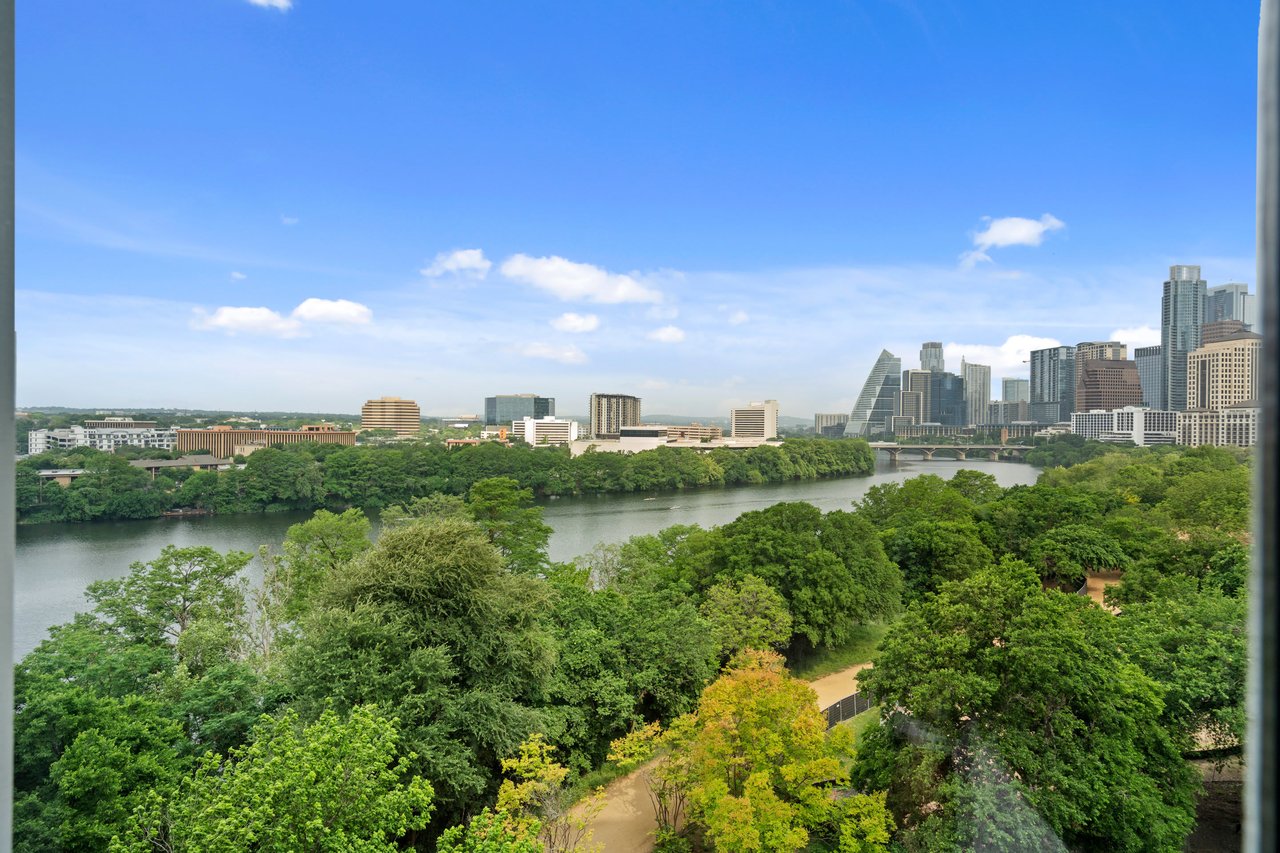
One pattern I increasingly encounter is a pairing: a lock-and-leave primary in Westlake, Tarrytown, or a downtown tower, plus a Hill Country property within a practical drive. The city residence carries school, airport access, and the workweek; the land carries weekends, holidays, and longer family time. For other clients, the ranch becomes primary and the city residence becomes the convenience address. The right structure depends less on fashion than on how the family actually lives.
The wealth-management industry has a bloodless term for the underlying strategy — lifestyle diversification — and the world's family offices are practicing it at scale, with surveys showing sustained appetite for direct real assets. But the local infrastructure tells the story better than the surveys do. At Austin-Bergstrom, Million Air broke ground last fall on a $50 million second phase — three 40,000-square-foot hangars totaling 120,000 square feet — with its chief executive noting that demand for premium hangar space "continues to outpace supply" and every bay expected to be spoken for before completion. An hour west, Horseshoe Bay Resort operates its own jet center with a 6,000-foot lighted runway the resort bills as the longest in the Highland Lakes. When a region starts building hangars the way it once built parking garages, the census has already happened; the infrastructure is just catching up.16
XI
What the Land Knows
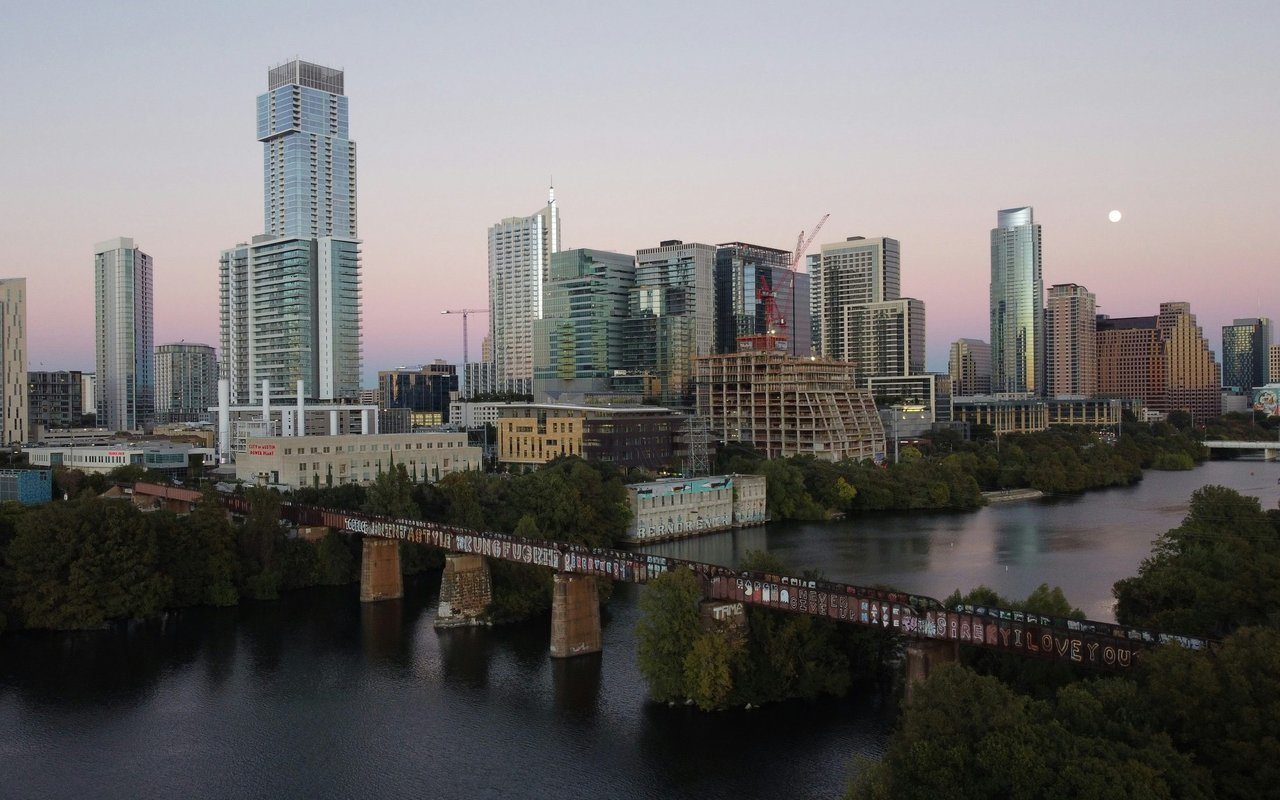
Twenty years ago, Austin's wealth was measured in skyline — cranes, towers, the vertical proof of arrival. The next chapter is also being written horizontally: in fence lines consolidated, springs protected, easements recorded, and families deciding that control over setting matters as much as square footage.
From an advisor's seat, the important distinction is between a land story and a sound acquisition. Scarcity alone does not make a property right. Water, access, restrictions, neighboring uses, carrying costs, and the family's real pattern of use still determine whether an acreage purchase will age well.
I do not tell clients that Central Texas land only goes up, that every view is protected, or that the next buyer will value a property exactly as they do. My role is to separate the romance from the utility, identify what is truly scarce, and make the risks visible before a family commits.
That is the practical meaning of control: understanding what you own, what can change around it, and whether the property still works when the story is stripped away.
Research apparatus
Source notes
These notes establish the claim-level source structure for staging. They do not clear the unresolved items documented in the companion ledger. Where a note identifies a remaining issue, the public page must not launch until that issue is resolved or the language is approved for revision.
- 1 Austin housing normalization
Texas Real Estate Research Center, “Housing | Winter 2026.” The Center reports an Austin median of $440,000 at mid-year 2025, 22% below the pandemic peak and 23% above 2020. The draft’s exact May 2022 peak and days-on-market sequence still require one locked MLS series.
Primary or supporting source ↗ - 2 Austin–Waco–Hill Country land market
Texas Real Estate Research Center, “Texas Rural Land Markets | First Quarter 2026.” Region 7 is reported at $8,028 per acre, up 8.27% year over year, with 1,078 annualized sales, 53,554 acres and $429.93 million in annualized dollar volume.
Primary or supporting source ↗ - 3 Million-dollar home sales
Texas REALTORS®, “Sales of Million-Dollar Homes in Texas — 2025 Edition.” For the Austin–Round Rock–San Marcos MSA, November 2024 through October 2025: 2,714 sales and $4,555,407,032 in volume.
Primary or supporting source ↗ - 4 Texas rural land, year-end 2025
Texas Real Estate Research Center, “Texas Rural Land Markets | Fourth Quarter 2025.” The report places statewide rural land at $5,214 per acre and discusses asking prices remaining anchored to 2022–23 peak expectations.
Primary or supporting source ↗ - 5 Austin population
City of Austin demographic materials and U.S. Census estimates. The exact wording and cutoff for the draft’s “twelve consecutive years” formulation remain an editor query.
Primary or supporting source ↗ - 6 Austin private-wealth estimates
Henley & Partners / New World Wealth, USA Wealth Report 2024. These are modeled private-wealth estimates, not Census counts.
Primary or supporting source ↗ - 7 Working lands and wildlife-management acreage
Texas A&M Natural Resources Institute, “Status Update and Trends of Texas Working Lands 1997–2022.” The report documents approximately 3.7 million acres converted from working lands and wildlife-management acreage rising from about 94,000 to about 7.1 million.
Primary or supporting source ↗ - 8 Open-space agricultural appraisal
Texas Comptroller of Public Accounts, agricultural and timber appraisal guidance. County-specific qualification and rollback-tax treatment should be confirmed for each property.
Primary or supporting source ↗ - 9 Wildlife-management appraisal
Texas Parks & Wildlife Department, agricultural tax appraisal based on wildlife management use. Eligibility generally begins with land already qualified for open-space agricultural appraisal and requires active management practices.
Primary or supporting source ↗ - 10 Groundwater and drought management
Texas Water Development Board groundwater FAQ and Hays Trinity Groundwater Conservation District management materials. District rules, drought stages and management-zone cutbacks can change and should be checked at the time of diligence.
Primary or supporting source ↗ - 11 Thomas Ranch
Thomas Ranch project materials. Development counts, phases and infrastructure status should be refreshed during final fact review.
Primary or supporting source ↗ - 12 Texas Hill Country wine geography
Texas Hill Country Wineries describes the Hill Country AVA as approximately nine million acres, the nation’s third-largest, with more than 100 wineries. Visitor-ranking claims in the draft remain subject to source confirmation.
Primary or supporting source ↗ - 13 Hill Country hospitality projects
Current operator and developer materials: Albert Hotel; Waldorf Astoria Texas Hill Country (expected 2027); Canyon Ranch Austin; and Aman’s announced Amansanu project. The status, acreage, pricing and opening language for every project must be locked immediately before publication.
Primary or supporting source ↗ - 14 Texas conservation lands
Texas Land Trust Council, Conservation Lands Inventory. The current inventory reports more than two million acres conserved by Texas land trusts, including more than one million through conservation easements.
Primary or supporting source ↗ - 15 Conservation-easement tax treatment
Texas Land Trust Council conservation-easement guidance and applicable federal tax law. All percentages, carryforwards and estate-tax language in the draft remain subject to legal and tax review before publication.
Primary or supporting source ↗ - 16 Private aviation
Million Air Austin Phase II materials show three 40,000-square-foot hangars totaling 120,000 square feet. Horseshoe Bay Resort states that its jet center has a 6,000-foot lighted runway. The article wording reflects the official Phase II hangar totals; timing, demand and preleasing language still require final verification.
Primary or supporting source ↗ - 17 Texas ETJs
Texas Local Government Code, Chapter 42, and Senate Bill 2038 implementation materials. The draft’s petition and acreage totals require a dated municipal or regional source before publication.
Primary or supporting source ↗

About the author
Sean Smith
Sean Smith is a Real Estate Advisor, REALTOR® with Engel & Völkers Austin | Lake Tahoe. He advises buyers and sellers across Austin and the Hill Country, with a focus on the practical questions behind exceptional homes, land, water, access, and long-term ownership.
seansmithatx.com
[email protected] · 817.909.1831